

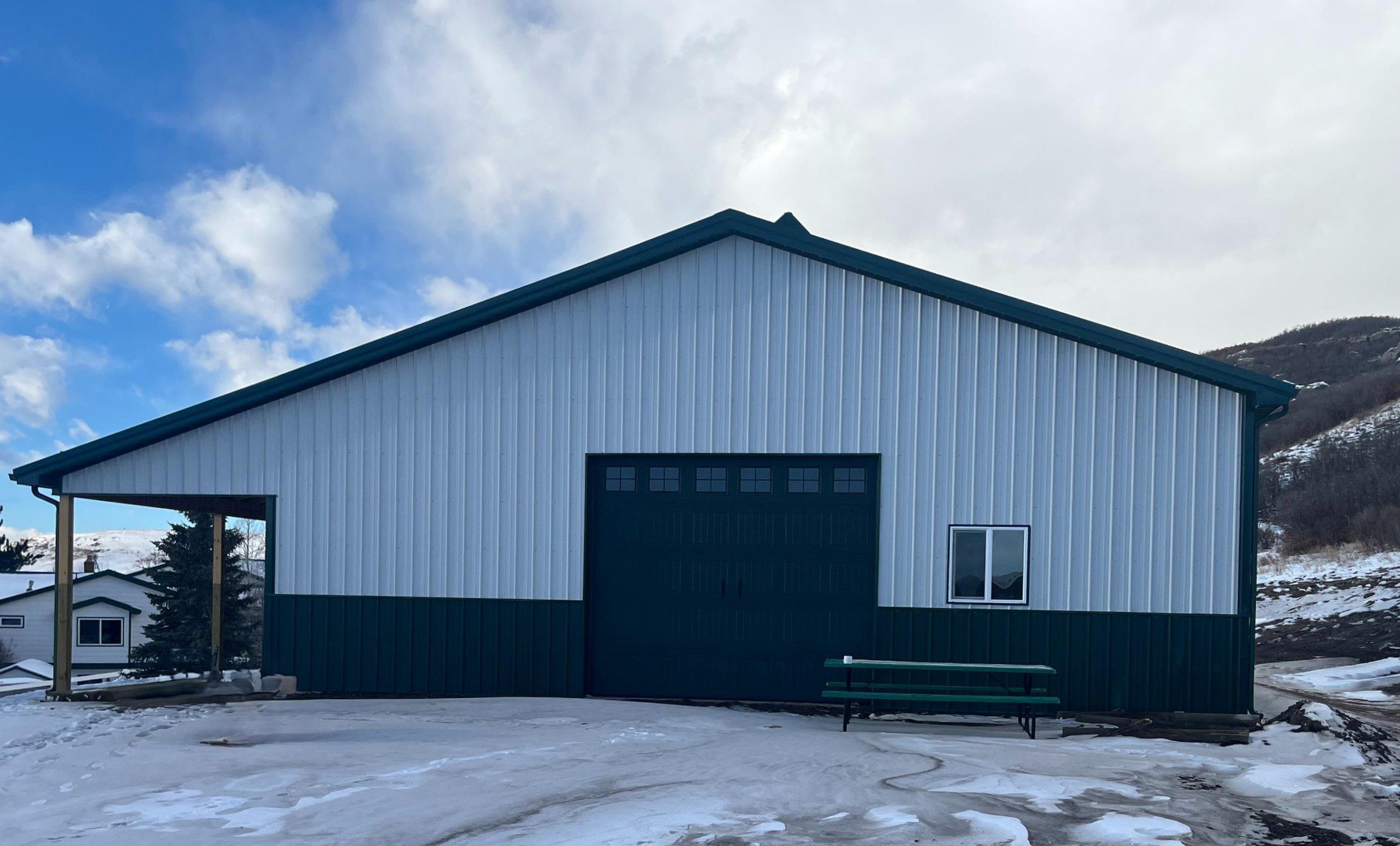
Pole barn buildings are versatile and can be used as horse barns, agricultural buildings, and storage facilities for additional vehicles, such as sports cars, RVs, and even small planes or helicopters. Why should you choose this construction method? The buildings are sturdy, affordable, and customizable with all the features of a traditional building. Pole barns can even be built on unlevel ground, gravel, or dirt.
Barns have been a feature of the American rural landscape for centuries, and the preservation of historic barns is encouraged. Did you know George Washington owned a round barn? Everyone assumes barns are rectangular, but in the 1880s, circular barns were seen as progressive. Do you want a custom structure? Peak Pole Barns and Manufacturing will use our expertise and experience to design and create the building you want.
What Are Pole Barns?
At its core, a pole barn is a versatile utility building, known for its strength, simplicity, and wide range of uses, from agricultural and commercial to residential projects.
Originally developed in the United States during the 1930s, pole barns emerged as a cost-effective solution for farmers seeking practical shelters for their equipment, hay, and livestock. Over the decades, this efficient building method has evolved into a trusted choice for a wide range of applications, from garages and workshops to horse barns and storage buildings.
A pole barn—also called a post-frame building—is built using large wooden or steel posts set deep into the ground or anchored to a concrete pier foundation. These structural posts support the entire framework, eliminating the need for load-bearing interior walls. Roof trusses span across the top, while exterior walls can be finished in metal siding (the most common choice), wood, or other durable materials.
This design creates an open, unobstructed interior space that’s easily customized to suit your needs. Check out this timelapse video of the complete pole barn building process!
What A Pole Barn Can Be Used For
Pole barns are ideal for horse barns and indoor horse arenas, but can be used for many more commercial purposes. It also makes an excellent house with a separate or attached garage. One of the commercial uses one would not normally associate with pole barns is cold storage.
Types of Post-frame Buildings We Design and Build
Agricultural Buildings
Peak Pole Barns designs and builds durable and functional pole barns for any rural needs. From equipment storage and hay shelters to livestock housing, milking sheds, and cow barns, our post-frame buildings offer the flexibility and strength required for daily farm operations. Each building is constructed to handle heavy use and harsh weather, ensuring long-term performance with minimal upkeep.
Barn-Style Garages
Looking for a garage with room for more than just your car? Our custom-designed barn-style garage in Colorado is built for trucks, RVs, trailers, and even boats. These garages can include multiple bays, overhead doors, storage lofts, and workshop space, making them ideal for rural homeowners who need more than a standard residential garage.
Horse Barns and Indoor Riding Arenas
As Colorado equestrians know, a quality horse barn or indoor horse arena is essential for training, care, and shelter. We design barns that include stalls, tack rooms, feed storage, wash bays, and foaling areas, all within a well-ventilated, thoughtfully planned layout. Indoor arenas provide year-round usability with open spans and consistent footing, aligning with industry standards and ready for commercial pole barn applications if needed.
All-Purpose Storage Facilities
Looking for a versatile type of building that adapts to your evolving needs? Our all-purpose storage facilities are ideal for tools, farm equipment, seasonal items, or business inventory. These pole barns are highly versatile, customizable, and built to last.
RV, ATV, or Classic Car Storage
Pole barns are an excellent solution for long-term vehicle storage. Designed to handle Colorado’s extreme weather, our barns offer climate control, insulation and flooring for your RVs, ATVs, motorcycles, or collector cars. It’s a smart building project choice for anyone needing protection and convenience without the cost of conventional stick-frame building.
Hangars for Small Aircraft
If you fly, we can build a pole barn hangar that provides secure, weatherproof shelter for your plane or helicopter. Our custom designs include wide-span doors, high clearances, and tailored access points.

The Benefits of an Indoor Horse Arena
The International Federation for Equestrian Sports, otherwise known as Fédération Equestre Internationale (FEI), is the world governing body for jumping, dressage and para-dressage, eventing, driving and para-driving, endurance, and vaulting. People who are passionate about these sports know that the United States has hosted FEI World Cup Finals for the last forty years. With such an active presence, participants have no doubt been using indoor horse facilities to practice for events. What other benefits would an indoor riding arena have?
Although horses have been roaming the prairies for longer than barns have existed and are quite resilient, they need a more controlled, comfortable environment to practice for hours. Pole barn buildings have fewer thermal breaks due to their construction method, making them better insulated and ideal for an indoor horse arena. Indoor riding facilities are also practical when you want to avoid distractions present during the daytime and choose to ride at night. Sensitive horses requiring focused attention will feel more comfortable when they are alone in the arena at night and not influenced by the presence of other horses.
According to Premier Equestrian, a specialist footing supplier, horses need a consistent surface to work on as it makes them feel comfortable, leading to fewer injuries. At the last Olympic Games, the composition of the footing used for training and competition arenas consisted of top-quality sand mixed with approximately 1.5% of polyester textile fibers. The sand provides
impact firmness and grip, while the fibers offer cushioning, responsiveness, and elasticity to promote optimal performance. A well-designed and constructed pole barn riding arena, with sufficient public facilities such as parking and toilets, can also be rented out for formal competitions or practice sessions.
Why Should You Invest In A Horse Barn?
The first question should actually be, “Why do you want to invest in a horse barn?” Do you want to provide a safe environment to attend to horse health or protection against harsh Colorado weather conditions? Maybe you want to start a new business or need to expand existing facilities. For many horse owners, the decision to build a barn is a practical one. Farms are busy places, whether they exercise racehorses or serve as a riding facility for amateurs, and owners want to keep everything they need for their horses in one space.
Horse barns include stalls, a tack room, a feed room, a wash bay, an equine infirmary, a foaling area, storage, and a rest room for grooms and attendants. On warmer days, one can wash horses in an outside stall, but in the harsh Colorado winter conditions, an indoor wash bay is a necessity. For practical reasons, it can also be used as a cleaning stall for tack and boots, and a grooming area.
To make this multi-purpose facility even more convenient, add sufficient storage space for the items used during grooming and cleaning. Mares tend to foal late at night or early in the morning, when it is dark, and they feel safe and comfortable. Unfortunately, humans do not feel equally comfortable when attending to a foaling in a paddock, making investing in a horse barn worthwhile. When stabling expensive competition horses, it makes sense to have a special stall where sick horses can be treated. Design easy-to-clean stalls that can be closed off from the rest, but ensure they have good lighting for the vet and an area for veterinary supplies.
How to Build a Pole Barn That Lasts
Pole barns should be considered as the primary construction method when gathering horse barn ideas. Why? It is a post-frame building where the structure is built around widely spaced posts or poles. The building is robust and sturdy, while the pole spacing design promotes enhanced ventilation, improved air quality, and increased comfort.
Peak Pole Barns and Manufacturing understands that successful pole barn construction for horse stables must account for functional elements such as water supply, manure disposal, feed storage, exercise space, loading and unloading access, and legal or other restrictions that apply to horse stable design.
Consideration Factors in Pole Barn Construction
Site choice
The site should be well-drained with easy connection to utilities and the driveway or road.
Considerations
Layout
Are you planning for more than four stalls? Put the tack and feed rooms in the middle so you will walk less.
Considerations
Stall size
Make the stalls big enough so horses don’t walk on soiled bedding the whole time, and center the stall door in the aisle wall. Build stall walls flush with the ground to prevent bedding wastage.
Considerations

Aisle size
Design a wide aisle so equipment and horses move around easily, and light enters from the doorways at both ends.
Considerations
Flooring
Cover concrete flooring with drainable rubber matting as it is easy to clean and gentle on the horses’ joints.
Considerations
Light
Increase natural light by placing windows in appropriate places. It is easier to work in, there are fewer flies, and it cuts down on the electricity bill.
Considerations
Ventilation
Air exchange rates for proper ventilation are based on the number of horses, barn size, and insulation type. Consult with an expert for optimal barn ventilation.
Considerations
Temperature control
Good air flow is vital to a horse’s health, so barn insulation installed to control temperature must allow for proper air flow.
Considerations
Dust management
Limit dust by feeding hay on the ground instead of a manger or bag, and store it in a separate building.
Considerations
Did you know cupolas, pronounced KYOO-pa-la, have a greater purpose than visual appeal? It serves as a ventilation system that draws warm, humid, and smelly air from a barn or building while letting natural light spill into the vaulted ceiling. Have you ever been to Faneuil Hall in Boston, where abolitionists, labor unionists, and women’s suffragists held meetings, debates, and protests?
The cupola on this building is called a belvedere or widow’s walk and used to be in the center of the roof in 1742. To reach it, you have to climb narrow stairs, but fortunately, we now have remote control systems that allow owners to easily open and close cupola windows and louvers. Just imagine the amazing light display a cupola on your indoor events arena offers if light fixtures are added, especially when it is rented out at night.
Interested in adding value, space, and durability to your property? Whether you’re looking to make a pole barn for storage, agricultural use, or even a home, Peak Pole Barns and Manufacturing can bring your vision to life. Our team specializes in pole barn buildings and complete construction of high-quality post-frame buildings throughout Colorado. From concept to completion, including custom steel fabrication, we handle every detail. Contact Peak Pole Barns and Manufacturing today to start planning your next project or request a quote.